

Your title is one line, and it appears next to the cover photo in every search. It has to say what the place is, why it is special and, ideally, who it is for. Most titles do only the first, and do it vaguely.
Key takeaways
- A strong title combines the place type, the standout feature and the guest it suits.
- Specific beats generic: name the view, the style, the location detail.
- Write for the guest’s search, then test and refine.
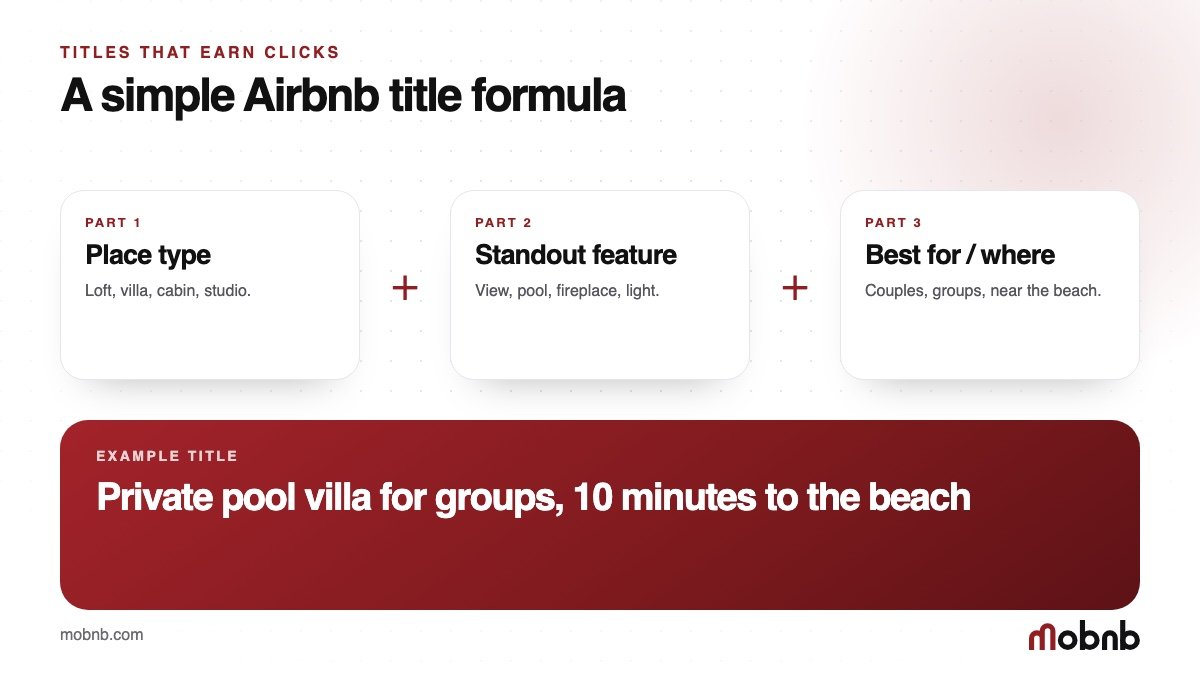
1. The simple formula
Place type + standout feature + best for / location hint. You will not always use all three, but this structure forces specifics.
2. Weak and stronger examples
- Weak: “Nice apartment in city centre.” Stronger: “Sunny loft with a balcony, five minutes from the old town.”
- Weak: “Beautiful villa with pool.” Stronger: “Private pool villa for groups, 10 minutes to the beach.”
- Weak: “Cozy cabin.” Stronger: “A-frame cabin with a fireplace and forest views, ideal for couples.”
3. Write for the guest’s search
Think about what a guest types or filters for: near the beach, quiet, workspace, family-friendly, pet-friendly. If it is true and important, it belongs in the title.
4. Avoid the common traps
- Stuffing the title with symbols or capital letters.
- Claims you cannot support, like “the best”.
- Repeating information already obvious from the photo.
5. Keep it consistent with the rest of the listing
The title makes a promise, and the photos and description should keep it. A mismatch between title and cover photo makes guests hesitate. See how to choose a cover photo.
6. Test and review
Change one thing at a time and watch the results over a few weeks. Titles are one of the cheapest changes you can test.
A rewritten title and description is part of our services. Want a second opinion? Start with a free listing review.
More title patterns to try
Once you have the basic formula, vary the angle depending on what makes your place special. Here are patterns for different types of property:
- View-led: “Sea-view studio with a balcony, steps from the harbour.”
- Guest-led: “Quiet workspace apartment with fast Wi-Fi, ideal for remote work.”
- Experience-led: “Treehouse retreat with a hot tub, for couples who want to switch off.”
- Location-led: “Bright flat by the metro, ten minutes to the old town.”
A quick title checklist
- Does it name the type of place?
- Does it name one standout feature?
- Does it hint at who it suits or where it is?
- Is every claim true and supported by the photos?
- Does it read naturally, without symbols or shouting?
Frequently asked questions
How long should an Airbnb title be?
Keep it short enough to read at a glance and not be cut off in search, then put the most important words first.
Should I use emojis or symbols in my Airbnb title?
Usually no. Clear words that describe the place and the guest it suits are more effective and look more professional.
How often should I change my Airbnb title?
Change it when you have a reason, such as a new feature or a new target guest, and test one change at a time so you can see the effect.
The short version
A good title is specific, honest and written for the guest you want. Use the formula, test one change at a time, and let the data guide you. Send us your link for a free listing review and we will suggest a stronger title.
Related reading: why descriptions that sell features lose bookings, the first-glance checklist and 7 common audit mistakes.